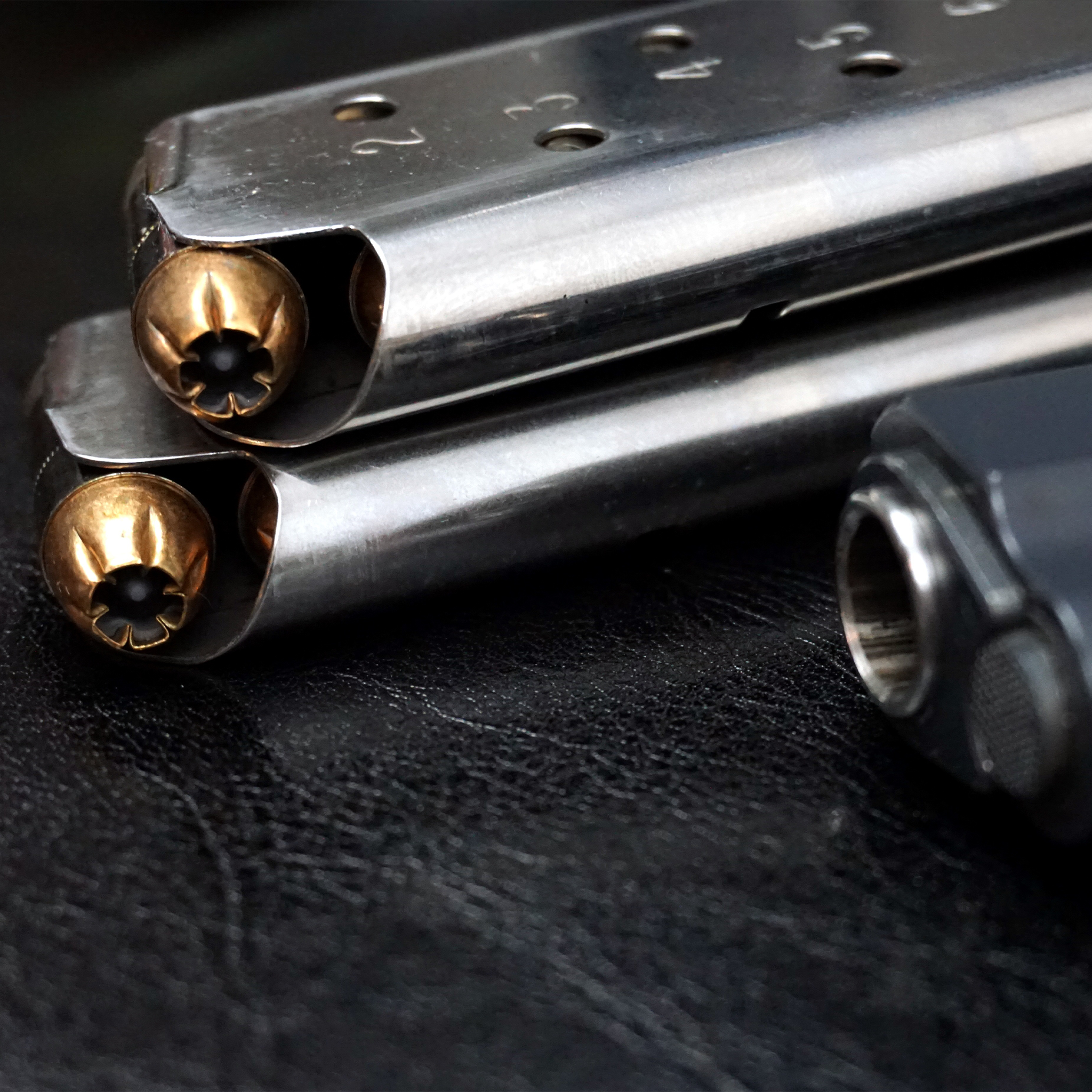
The 9mm vs. .380 Debate: More Than Just Millimeters
Place a .380 ACP round next to a 9mm Luger and the similarity is immediately obvious. Both cartridges fire the same .355-inch diameter bullet, which is one reason the comparison causes so much confusion among shooters.
Both the .380 ACP and 9mm Luger also fire the exact same .355-inch diameter projectile. These facts create more confusion in the ammunition market than perhaps any other caliber comparison. Shooters routinely assume these are fundamentally different rounds when, at the bullet level, they're not.
Terminology Check: The .380 ACP is formally designated the 9x17mm — often called the "9mm Short" — while the standard 9mm is the 9x19mm Luger. The difference isn't the bullet; it's the case length and the powder charge it holds.
That 2mm case length gap is where the performance divergence begins. The 9x19mm's longer case accommodates more propellant, generating significantly higher chamber pressure and, consequently, superior 9mm ballistics across every measurable metric; velocity, energy, and downrange performance.
The trade-off is real, though. The .380's shorter, lower-pressure design enables smaller, lighter, more concealable platforms. This is the central tension defining the comparison: raw ballistic performance versus practical carry comfort.
Understanding that tension, and exactly how wide the performance gap actually is, requires a closer look at what that extra 2mm of case length delivers downrange.
Ballistic Reality: Why the 9mm Packs a Bigger Punch
The 9mm generally produces significantly more muzzle energy than .380 ACP. 9mm rounds typically generate 264–335 foot-pounds of energy, while .380 ACP averages just 152–182 foot-pounds.
Case length explains most of this gap. The 9mm's 19mm case versus the .380's 17mm case creates more internal volume, allowing for additional powder and higher chamber pressure. A small dimensional difference produces an outsized performance result.
That energy advantage translates directly into penetration. In ballistic gelatin testing:
-
.380 ACP typically penetrates 9–11 inches
-
9mm routinely achieves 13–15 inches
On the "stopping power" debate — it's worth being precise. Neither round guarantees an immediate stop, and shot placement remains the dominant variable. However, objective energy figures don't lie: deeper penetration means a projectile is more likely to reach vital structures through intermediate barriers like clothing or muscle tissue.
That said, raw power isn't the whole story. How a round performs means little if you can't control the platform delivering it — which is exactly where the .380's real argument begins.
The Recoil Tax: Why .380 ACP is the 'Comfort' King
The .380 ACP's strongest selling point is the shooting experience itself, and that distinction matters enormously for the right user.
When comparing 9mm vs 380 ballistics, the physics that make 9mm more powerful work directly against shooter comfort. In identical-weight firearms, the .380 ACP produces approximately 50% less felt recoil than the 9mm.
The .380 ACP is the right tool when reduced recoil directly enables better shooting, not just more comfortable shooting.
Platform size adds another layer of complexity here. A compact, lightweight 9mm pocket gun can actually feel more punishing than a larger, heavier .380 — because there's less mass to absorb the energy. In practice, a full-size .380 may deliver a gentler shooting experience than a subcompact 9mm, even though the calibers are reversed in power.
Faster follow-up shots are the practical payoff. Manageable recoil means faster sight recovery and tighter shot groupings under stress — advantages that can outweigh raw ballistic performance.
Range Training: 9mm
The caliber you can afford to shoot consistently will always outperform the caliber you shoot sparingly — and that's where .380 ACP quietly loses ground.
Price Comparison — Typical Range Ammo Costs:
-
9mm FMJ: $0.17–$0.25 per round
-
.380 ACP FMJ: $0.22–$0.34 per round
That 25–35% price premium on .380 ACP stems from lower production volume. The 9mm is the world's most manufactured pistol cartridge, and that scale drives costs down significantly.
Annual cost difference: A recreational shooter firing 1,000 rounds per year pays roughly $170–$250 for 9mm versus $220–$340 for .380 ACP — a gap of $50–$90 annually. That's real money that could fund two or three additional range sessions.
Lower cost drives higher volume. More rounds downrange means faster skill development, tighter groupings, and better muscle memory. Many shooters recommend 9mm to beginners simply because the lower ammunition cost makes regular practice more affordable. When .380 acp ballistics are already a step behind, paying more to practice less compounds the disadvantage.
Availability matters too. In practice, 9mm fills shelves at virtually every sporting goods retailer and big-box store, while .380 ACP can be harder to source — particularly during supply crunches. That inconsistency alone disrupts training schedules.
Those cost and availability gaps translate directly onto the range, which is where target choice starts shaping the conversation.
Which Caliber Is Better for Range Practice?
For most shooters, 9mm is generally the better choice for frequent range practice. Its combination of affordable ammunition, widespread availability, and versatility makes it one of the most practical calibers for building shooting skills over time.
Because 9mm ammunition is typically less expensive than .380 ACP, shooters can often afford more range time for the same budget. More trigger time means more opportunities to improve accuracy, build confidence, and develop consistent shooting fundamentals.
That doesn't mean .380 ACP is a poor choice for training. In fact, many shooters appreciate its lighter recoil, especially those with smaller hands, reduced grip strength, or sensitivity to recoil. The softer shooting experience can make practice sessions more comfortable and enjoyable, encouraging shooters to spend more time on the range.
When it comes to target shooting, both calibers can be used effectively on paper targets and properly rated steel targets when appropriate safety distances are followed. However, 9mm's higher velocity and energy often produce more noticeable feedback on reactive targets and steel, creating a more satisfying shooting experience for many recreational shooters.
Ultimately, the best caliber for range practice is the one that encourages you to train consistently. A shooter who practices regularly with a .380 ACP will generally outperform a shooter who rarely trains with a 9mm. Consistency, repetition, and quality practice matter far more than small differences in caliber performance.
Range Performance: Choosing the Right Targets
Target choice shapes the shooting experience more than most people realize. While both .380 ACP and 9mm are enjoyable range calibers, their differences become more noticeable when shooting reactive and steel targets.
Both .380 ACP and 9mm can be used safely on properly rated steel targets when appropriate safety distances are followed. However, 9mm generally produces more audible feedback and more consistent target movement on reactive steel due to its higher velocity and energy.
For recreational shooters, both calibers perform well on paper targets, cardboard IPSC silhouettes, and steel plates. The .380 ACP's lighter recoil can make it especially enjoyable for accuracy drills and extended practice sessions, while 9mm's added energy often creates a more dynamic experience on reactive targets.
One advantage of 9mm is its versatility. From paper drills to reactive steel targets, the caliber performs consistently across a wide range of training scenarios. Combined with its lower ammunition cost, this makes 9mm a popular choice for shooters who spend significant time on the range.
Ultimately, target feedback plays an important role in both enjoyment and skill development. Hearing the ring of steel, seeing a target move, and getting immediate confirmation of a good hit can make practice more engaging and rewarding.
Whether you choose .380 ACP or 9mm, consistent practice with quality targets will have a far greater impact on your shooting performance than caliber selection alone.
The Bottom Line: Which Caliber Should You Buy?
When weighing .380 ACP vs 9mm, the right choice depends on your goals, budget, and how often you plan to train.
-
9mm is the "Goldilocks" round — cost-effective, high-volume friendly, and powerful enough to deliver 13–15 inches of ballistic gel penetration
-
.380 ACP is a specialized tool — purpose-built for deep concealment or shooters managing hand strength issues, arthritis, or injury-related recoil sensitivity.
-
Penetration favors 9mm — it wins the terminal ballistics argument decisively. However, a .380 that a shooter can control accurately still outperforms a 9mm they flinch through.
-
Training volume tips the scales — if you're putting rounds downrange consistently, 9mm's lower cost per round compounds into a meaningful skill advantage over time.
-
Try before you commit — rent both platforms at a range before purchasing. Real trigger time under realistic conditions will tell you more than any spec sheet.
Neither caliber is universally superior; the best round is the one you'll train with and carry confidently. For most shooters, 9mm delivers the optimal balance. For a targeted few, .380 is exactly the right tool. With the core differences now clear, the next step is a clean side-by-side breakdown of the numbers that define each caliber.
Summary of Key Differences
The 9mm Luger and .380 ACP are closer relatives than most shooters assume — yet their practical differences in power, cost, and handling are decisive for self-defense selection.
-
Both calibers share a .355-inch bullet diameter. The critical distinction is case length: the 9x19mm runs 2mm longer than the 9x17mm .380 ACP, allowing it to hold significantly more propellant and deliver roughly 67% greater muzzle energy downrange.
-
9mm is the cost-efficient training caliber. At 25–35% lower cost per round, it supports the high-volume repetitions needed to build real defensive competency — and it's the clear choice for reactive steel target practice.
-
The .380 ACP's recoil advantage is measurable. Generating approximately 50% less felt recoil, it remains the most practical option for shooters managing hand strength limitations, arthritis, or injury recovery.
-
Neither caliber is universally superior. The 9mm wins on ballistic performance and economy; the .380 wins on shootability for specific populations.
The bottom line: caliber selection is a capability decision, not a prestige one. Match the round to your hands, your training frequency, and your carry platform — because the most effective self-defense round is the one you can deploy accurately under pressure, every time.